
The commercial landscape of Norwich is undergoing a massive transformation. From the revitalization of historic industrial spaces in the city center to the development of cutting-edge retail hubs, office spaces, and modern warehouses, properties must meet strict modern standards. Whether you are upgrading an existing retail floor, remodeling an office complex, or preparing a large industrial warehouse for heavy machinery, the foundation of your building dictates the success of the entire project.
To prevent these issues, using a high-performance floor leveling compound for concrete has become an essential phase in modern commercial renovations. This guide explores the engineering, benefits, and practical steps commercial property owners in Norwich must consider to ensure their floors remain durable, safe, and perfectly flat.
The Industrial Demand for Level Flooring in 2026
The structural demands placed on commercial floors in Norfolk have risen dramatically over the past few years. Warehouses now utilize taller racking systems, offices house complex technological setups, and retail spaces see continuous foot traffic.
Automated Logistics and Warehousing
As businesses increasingly adopt automated guided vehicles (AGVs) and high-density racking systems, floor tolerance has become critical. A deviation of just a few millimeters at the base can translate into a dangerously misaligned rack or an automated forklift sensor failure at heights of 10 meters or more.
High-Traffic Retail and Office Spaces
For customer-facing businesses, an uneven floor is a severe liability. According to data published by the UK Health and Safety Executive (HSE), slips, trips, and falls remain the most common cause of major injuries in the workplace, accounting for over 30% of all reported employer liabilities.
What is a Floor Leveling Compound for Concrete?
A concrete leveling compound, often referred to as a self-leveling underlayment, is a highly specialized, polymer-modified cementitious mixture. Unlike traditional thick concrete mixes, it features high fluidity and low viscosity.
- Self-Smoothing Properties: Once poured onto a prepared subfloor, the mixture spreads rapidly across the surface, utilizing gravity to flow into low spots, dips, and gouges.
- Rapid Tensile Strength: Formulated with advanced polymers, it creates a incredibly dense, flat layer that bonds tenaciously to the existing concrete base.
- Variable Applications: Depending on the specific product variant used, it can be applied in feather-edge layers as thin as 1mm up to deep-fill applications exceeding 50mm in a single pour.
Key Benefits of Self-Leveling Underlayments in Commercial Properties
Implementing a professional leveling underlayment offers substantial long-term technical and financial benefits:
- Protects Expensive Floor Finishes: Eliminating subfloor unevenness prevents brittle floor tiles from cracking under heavy weight and keeps flexible vinyl from stretching or tearing.
- Drastically Reduces Downtime: Commercial operations cannot afford long closures. Modern leveling compounds dry rapidly, allowing foot traffic within 2 to 4 hours and final floor installations within 24 hours.
- Improves Structural Durability: The specialized polymer blend fills minor surface micro-cracks, reinforcing the structural integrity of the old concrete slab beneath.
- Enhances Moisture Barriers: When applied alongside liquid damp-proof membranes (DPM), it helps seal out rising ground moisture, protecting the building from dampness.
The Step-by-Step Leveling Process
Achieving a flawless commercial floor requires technical precision. Cutting corners during the preparation stage is the leading cause of underlayment failures, such as bubbling, cracking, or peeling. A professional installation follows a strict sequence:
1. Thorough Surface Preparation
The existing concrete slab must be completely clean, dry, and structurally sound. Professional crews use mechanical shot-blasting or diamond-grinding to strip away old adhesives, oils, grease, curing compounds, and loose laitance.
2. Sealing and Priming
Once the dust is fully extracted, an acrylic or epoxy primer is applied to the bare concrete. The primer serves two critical purposes: it stops the porous concrete from sucking water out of the leveling mix too quickly, and it creates a strong chemical bond between the old slab and the new compound.
3. Mixing and Application
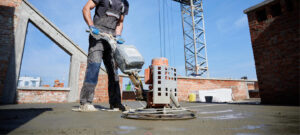
The compound is mixed using specialized industrial dual-paddle mixers or continuous pumping rigs to ensure a completely lump-free consistency. It is then poured onto the primed floor and spread evenly using a heavy-duty gauge rake.
4. Aeration with a Spiked Roller
Immediately after pouring, workers pass a spiked roller through the wet compound. This releases any trapped air bubbles that formed during mixing, preventing tiny pinholes and weak spots from ruining the finished surface.
Choosing the Right Norwich Specialist for Your Project
Commercial groundwork is an intricate science that requires heavy machinery, deep material knowledge, and strict adherence to British standards. Property owners should partner with locally proven, accredited contractors who understand the regional soil profiles, climate variables, and structural demands of Norfolk.
HM Groundworks and Construction Ltd brings 15 years of industry-leading experience directly to your commercial site. As fully SafeContractor approved, SSIP accredited, and ISO-certified professionals, their team handles everything from complex structural excavations to the final finish. When you work with experienced concrete floor installation contractors, you ensure that your commercial project is executed with advanced batching, pumping, and smoothing techniques built to stand the test of time.
Conclusion
A beautiful, long-lasting commercial floor is only as good as the foundation beneath it. In 2026, as flooring materials become more advanced and business environments demand higher performance, investing in professional floor leveling is an absolute necessity. By correcting surface flaws early with high-quality polymer compounds, you protect your property investment, avoid operational downtime, and ensure a safe, smooth environment for your staff and clients for years to come.